

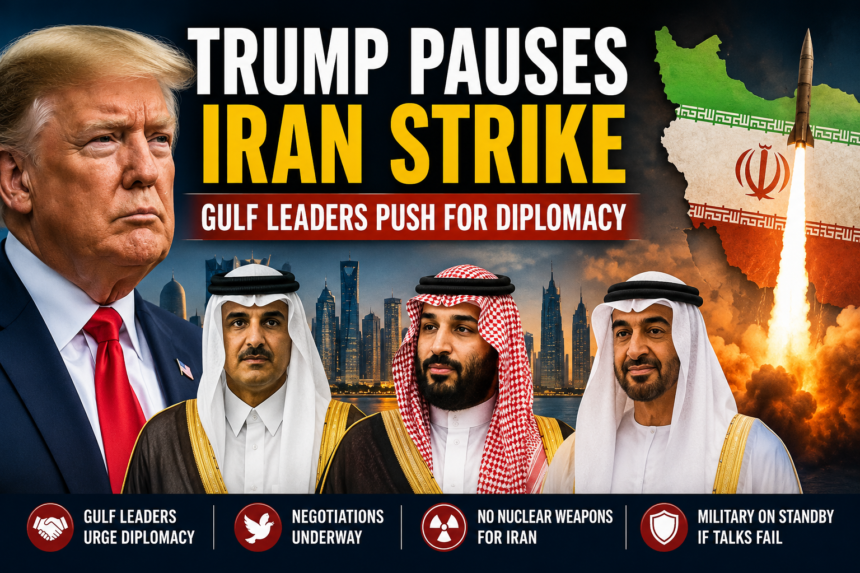
Tensions across the Middle East took another dramatic turn after Donald Trump announced that a planned U.S. military strike against Iran had been postponed following direct requests from leaders in the Gulf region.
In a statement posted on Truth Social, Trump claimed that the Emir of Qatar, the Crown Prince of Saudi Arabia, and the President of the United Arab Emirates urged him to delay the operation because serious negotiations are currently underway.
According to Trump, the military strike had been scheduled for the following day. However, he said Gulf leaders believed diplomacy still had a chance to succeed and could lead to a broader regional agreement that prevents Iran from obtaining Nuclear Weapons.
Trump Says Military Remains Ready
Although Trump stated that the attack would not move forward immediately, he also made it clear that the U.S. military remains on standby.
In his statement, Trump said he instructed military leadership to remain prepared for a “full, large scale assault” if negotiations fail or if an acceptable agreement is not reached.
The message reflects a strategy that combines diplomatic pressure with military deterrence. While the pause may reduce immediate fears of escalation, the warning signals that tensions between Washington and Tehran remain extremely high.
Why Gulf Countries Want Diplomacy
The involvement of Gulf nations is significant because countries like Qatar, Saudi Arabia, and the UAE would likely be directly affected by any large-scale military conflict involving Iran.
Regional leaders have long expressed concern that a direct confrontation could destabilize the entire region, disrupt trade routes, threaten energy infrastructure, and trigger broader security risks throughout the Middle East.
Oil markets also closely monitor these developments. Any escalation involving Iran can quickly impact global oil prices because of the region’s importance to international energy supplies.
By encouraging diplomacy, Gulf leaders appear to be trying to avoid another major conflict while still supporting efforts to limit Iran’s nuclear capabilities.
Iran Nuclear Concerns Continue to Drive Tensions
The issue of Iran’s nuclear program remains one of the biggest sources of conflict between Tehran and the United States.
American officials and regional allies have repeatedly argued that Iran must not be allowed to develop nuclear weapons capability. Iran, meanwhile, has consistently maintained that its nuclear activities are intended for peaceful purposes.
Trump’s statement specifically emphasized that any future agreement must guarantee “no nuclear weapons for Iran,” highlighting that the nuclear issue remains central to ongoing negotiations.
Pakistan Reportedly Playing a Diplomatic Role
Reports from Reuters suggest that Pakistan has also become involved in diplomatic communications tied to the crisis.
According to reports, Pakistan delivered a revised Iranian proposal to the American side as efforts continue to reduce tensions and prevent further military escalation.
Iranian Foreign Ministry spokesperson Esmaeil Baghaei reportedly confirmed that Iran’s response had been conveyed to U.S. officials through Pakistan, though additional details were not publicly disclosed.
The development highlights how multiple regional players are now attempting to prevent the situation from spiraling into a broader conflict.
What Happens Next?
The coming days could be critical for the future of negotiations between the United States and Iran.
If talks progress successfully, the region could avoid another major military confrontation and potentially move toward a new diplomatic framework surrounding Iran’s nuclear program.
However, Trump’s warning that the military remains prepared for immediate action also shows how fragile the situation remains.
For now, the Middle East continues to watch closely as diplomacy, military pressure, and international negotiations unfold simultaneously behind the scenes.